Taking on tar sands

The Canadian tar sands is often called the biggest and most destructive industrial project on the planet. If we want to prevent catastrophic climate change this is where the line must be drawn. The action currently being undertaken in the US to halt the Keystone XL pipeline is a crucial battle in the fight to end tar sands extraction.

Taking on Tarmageddon: Trailer from Taking on Tarmageddon on Vimeo.

Earlier this year I spent two weeks filming the documentary Taking on Tarmageddon following a group of students from the UK campaign network People & Planet investigating the tar sands. At the invitation of the former chief Al Lameman, we spent our time there staying with the Beaver Lake Cree Nation who are at the front lines fighting the oil companies to preserve their land, their hunting grounds, their health, even their way of life, both traditional and modern.

One of the first things to hit me was the contrast between where we were camping on the reservation and the utter destruction that we would see when we visited places like Shell’s Scotford Upgrader or Devon’s Jackfish in-situ projects. It made it all the more real what stands to be lost on a local level from the tar sands.

Taking on Tarmageddon: In-situ Extraction sites from Taking on Tarmageddon on Vimeo.

This was further compounded when we attended the Beaver Lake Cree Nation Pow Wow. As we watched the dancers in their amazing costumes the complexity of the issues around the Beaver Lake Cree’s fight against the tar sands began to sink in. Earlier that day we had been chased by security around various in-situ extraction sites near Conklin.

The first shot of the video from this trip shows the level of destruction caused by tar sands. So this might seem black and white, but the only reason we were able to get around the in-situ sites was that our driver from the Beaver Lake Cree reservation was a former oil-patch worker. And that’s the issue with the tar sands in Canada. Everything and everyone is linked to the tar sands. Every job in some way contributes to the oil industry. It was not an expected finding for us.

We were very lucky to be able to interview a First Nation man who is a former oil worker. He told us about how every day on his way in he had to drive past a native burial ground in the middle of an oil patch. He had to look at it, fenced off and surrounded by total devastation to the natural world. He told us that if he was to go to it and make an offering of tobacco, even just to throw a couple of cigarettes over the fence, he would lose his job. He got to the point where he just couldn’t do it anymore, he was faced with making a decision that involved not only quitting that job, but refraining from having anything further to do with the oil sands. However, he couldn’t say he’d never go back, he had to make the decision between living by his morals and providing for his family.

This is the same choice that faces every Albertan: do they provide for their families doing something so destructive or do they struggle to find work elsewhere?

While we were driving around Conklin we saw early construction and clearing work on the Harvest BlackGold project due to start producing bitumen in 2015 at an estimated 30,000 barrels per day. Due to this massive expansion in tar sand operations it is estimated greenhouse gas emissions from all tar sands projects will increase from 27 million tons per year in 2006 to 144 million tons per year in 2020. And it is only because of this expansion that projects like Keystone XL are even being considered.

The students in Taking on Tarmageddon are in the UK now planning their campaign. The film will be a crucial part of this campaign, allowing them to communicate their message further and wider than they would otherwise be able to. In November a group of young people from the Beaver Lake Cree Nation will come to the UK to continue building international solidarity to bring and end to tar sands extraction and a genuine transition to renewable energy.

What went wrong with No Pressure

The No Pressure film lasted all of about 12 hours on the internet. The overwhelmingly negative response pressured 10:10 to remove it, but the damage was done someone captured it from Youtube and within minutes of it being blocked it was up again through a different account. I think the real epic fail here was the response from 10:10, not the film itself.

Initially, with the flood of negative comments that came from both the climate change movement and the right-wing deniers, this seemed like an unmitigated disaster. Certainly through the narrow perspective of Youtube and Twitter, it was nothing short of a catastrophe.

The video was offensive on a number of levels, both to those inside and to many people outside the climate change ‘movement’. One of the perpetual problems with the whole 10:10 campaign is the emphasis that if we all ‘do our bit’ we can solve climate change. I am by no means the first to say that this is bollocks, George Marshall said it better than I will ever be able to. The common response to this is to say “but industry and governments are signed up too! Even e.on are part of it!” and that kind of illustrates the problem with it. If it is easy for e.on to be part of and still aim to build coal fired power stations, then it is clearly missing the point. It’s like BP saying “from now on we are going to use biodiesel in the boats that drill the oil wells”. This video is essentially saying “if you don’t do your bit we’ll track you down and kill you”. So maybe we can take the killing bit with a pinch of salt but the point is the same, they are delibertately putting the emphasis on individual action rather than where it needs to be; on governments and industry.

But I think an even bigger fail was the way that 10:10 seem to have handled the controversy around the video. So far all that has happened is they took the video down and posted an apology about it’s offensiveness. This did, however, take them the best part of a day to put it up, not the quickest response, nor the most effective. Far better it would have been to get out on Twitter and on the blogs and join in the conversation. Had 10:10 refused to be defeated, had they stood their ground and said “we’re sorry if you were offended, but the point of the film was to say that we need to act now to stop climate change” then they would have come out a lot stronger and they would have been able to change what people were talking about; from the shockingness of the film, to the issue it was trying to address.

Shocking films can work in campaigning, they definitely have their place but they have to be done right, NSPCC have had a few that have been very good. The problem is when the content becomes more shocking than the concept and that is what has happened in this case: the image of blowing children up is more disturbing than climate change.

It seems that this was an ill-conceived idea carried out poorly and to not have a plan for what to do if it all goes wrong is largely unjustifiable, given that this was a fairly predictable scenario. So I think it’s a fail for the film but an epic fail for the response.

Add to FacebookAdd to DiggAdd to Del.icio.usAdd to StumbleuponAdd to RedditAdd to BlinklistAdd to TwitterAdd to TechnoratiAdd to Yahoo BuzzAdd to Newsvine

FaceTweet it! Like This! Add to Google Buzz

Why Media Spin is So Dangerous for Society

The recent Camp for Climate Action at RBS’ Global HQ outside Edinburgh was typically reported with all the originality of Die Hard 4. The right-wing media rolled out the usual cliches; hippies, unwashed, posh, idiots, students etc. And the left-wing media was, mostly, supportive. Nothing new there. But then the media seemed to turn on Climate Camp. Articles on the, usually supportive, Guardian website were extremely critical accusing the camp of stifling free speech and reporting our lack of interest in Twitter as a failure of the camp as a whole.
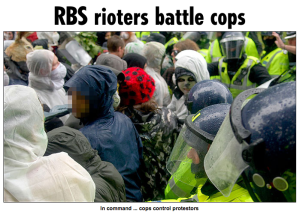
There were also many newspaper reports that were simply not true. The Sun ran with the headline “RBS Rioters Battle Cops” illustrated with a photo of some protesters next to some police. Had The Sun used a wider crop of this image their readership would have realised the inaccuracy of the article. The protestors are not ‘battling’ the police (they all have their backs to the police) but are steadying a prop siege tower that was wheeled, painfully slowly, toward the police line. There was certainly no rioting, at all, anywhere on the site. It is a wonder that the Sun ignored the siege tower, for many of us on site we thought that it would be the image that dominated the media coverage.

There was a significant amount of coverage surrounding the phantom “oil slick” on the A8 outside RBS’ head office. This was alleged by the Lothian and Borders Police, though no evidence has turned up to suggest it actually happened. Regardless of the lack of evidence, media outlets jumped on the story and reported it without a moments thought for editorial integrity.

Again, as in years before, the police paraded a “cache of weapons” in front of the media, this year it was a hammer and a chisel, though it is still unclear where these came from – there is no press release from the Lothian and Borders police relating to the items. In the Sun article on the Climate Camp, with no regard to journalistic integrity or adherence to the truth, these were instantaneously pluralised, making the alleged crime appear greater.

Another disturbing example from The Sun comes slightly further down the page. Not only do they repeat the totally unfounded accusations that Climate Campers where responsible for the phantom oil-slick on the A8 but they, either deliberately or unknowingly, attribute more legitimacy to the story through their formatting of the quote from the Police.

The placement of these comments suggests that both the police spokesperson has made this entire comments and that someone from Climate Camp has taken responsibility for the phantom oil incident – for which, to say they have not is an understatement. In fact the two statement refer to two completely separate events that happened many miles apart from each other.

These are just a couple of examples from one article in the, famously right-wing and reactionary, Sun newspaper. Though suspiciously absent from it’s website this weekend is any reporting on the activities of the National Front with a PR strategy English Defence League in Bradford. Whilst this might be commendable (personally I think fascists should be kept as far from the media as possible) their history on reporting of the activities of the EDL suggest they might have other motives.

In July this year, they reported on the arrest of EDL member John Broomfield on charges of plotting to bomb a mosque. The circumstances of this incident are subject to question as there were no charges made, but the reporting of it seems to downright support the EDL, particularly when compared to the reporting of the Climate Camp.

The emphasis throughout the article is on the accused being innocent, whilst this may be the case, were the accused of Asian descent I can’t help but feel this might be slightly different. The image used to portray Broomfield shows him ‘defiant and patriotic’ in an England t-shirt. Look at any of the articles about Muslims accused of terrorism and they are all police mugshots.

“So what?” I hear you cry “a right-wing newspaper being right-wing, big whoop”. Thing is, though, the trend in all media is towards reporting assumptions, based on cliches and stereotypes, regardless of what actually happens. So what are peaceful protests become “riots” and “battles”, all Muslims become “terrorists” and racists are heralded as working class heroes. This sort of reporting is dangerous because it legitimises these stereotypes. It is naive and wrong to say that people don’t believe things just because they are in the media, people only believe things when they are in the media.

In Malcolm Gladwell’s book Blink he references a psychology test that demonstrates how the reinforcement of images in society really can shape how people see each other. People gave significantly more positive responses to word association tests regarding black people when they had spent 30 minutes before the test looking at pictures of people like Nelson Mandela, Desmond Tutu or Martin Luther King.

What this shows is that the views of the EDL are based on media lies. Since the majory of UK media only, or biased to the extent that they might as well only, report negative stories about Muslims and immigrants we perceive them negatively. And so it is the same for protesters at Climate Camp, the reporting turns on them, so the people don’t support them and the association with climate change becomes negative.

If you listen to the media it seems we are almost on the verge of a race war, yet there is little (no) evidence to suggest this is actually the case. The vast majority of people get along fine and immigration is a huge benefit to the UK economy, not to mention to society.

This is why I am so angry with The Guardian for turning on the Camp. The Guardian, more than any other mainstream media outlet, has supported the Camp for Climate Action. But last week it chose to put out a series of very negative articles about Twitter “backfiring” on the Climate Camp and alleged attempts to stop freedom of speech, no doubt partly in retaliation for journalists being called “weak and cowardly” and “lazy” in a media guide, even though it was written by Guardian regular George Monbiot (does the failure to research that prove them lazy?). I don’t think the Guardian has a responsibility to always support the Camp, but they, like every other media outlet, has a responsibility to be apt and not misleading.

It seems so many of the ills of modern society can be traced back to mass representations; obsession with celebrity, fear of Islam (and the perception of any Muslim as a terrorist), mass consumption, political/environmental/sociological apathy. So this is my plea: please media, just FUCKING STOP IT! If we fill the media with positive images our wider perceptions will change and it is YOUR RESPONSIBILITY to do this.

Read the response from Climate Camp to the Guardian articles here, here and here.

“Football fans should be forced to pay policing bill” says Councillor

Councilor William W. McBraveheart today made a statement saying that football fans should be forced to pay an extra fee on top of their tickets to cover the cost of policing football matches in the future.
“Why should the innocent citizens of the area who have no interest in football have to foot the bill for entertaining a bunch of drunken hooligans”.

At recent games the policing costs of football matches have been known to cost more than a billion pounds of taxpayers’ money. Each game requires huge numbers of police on standby in case of violent clashes between the hooligans and police. There is also the cost of further policing into the evening after the matches and as the hordes of intoxicated yobs descend on city streets to wreak havoc – frequently causes fights and property damage.

Chief Constable B. Acon of the police force said “we have to deploy hundreds of police for each event and pay overtime, this means it can be extremely expensive to police football matches, often costing upwards of a trillion pounds.

“if we were to recover that cost from the boozed-up thugs themselves it would mean the taxpayer does not have to foot the bill” he added.

As football matches are a frequent occurrence the annual bill for policing of these events can run into the squillions of pounds. A spokesperson for the Football and Beer Alliance said “wehaaaayyy, yeah f**kin wicked mate, gonna smash the f**kin copper in the face”.

Councilor McBraveheart added “if we are able to make those responsible for crimes pay for the policing they are responsible for it takes the financial burden off the taxpayer and the accountability away from the police force, allowing them to be more effective at tackling crime and domestic extremism like the inebriated rapscallions responsible for football violence”.

Are we heading for an Oil-Crunch?

worldofoilbybarbaradodukLeading environmentalists, major national companies and industry experts have increased calls for more action on what has been called the “oil crunch”. Environmental entrepreneur Jeremy Leggett wrote in The Guardian recently about how we are heading for an oil crunch within the next decade. Leggett heads up the UK Industry Task Force on Peak Oil and Energy Security and has warned how we could see the same crash that happened to the banks happening with global oil reserves. The task force has claimed that oil production will hit its peak in 2015 after which we will see a rapid decline in production whilst demand continues to increase, a claim supported by major UK companies such as Virgin and Stagecoach. The report by the task force highlights concerns that draw parallels with the causes of the credit crunch. They are concerned that there may be significant flaws in the oil reserve estimates by OPEC countries, similar to the flaws in the value placed on “toxic loans”. This would mean that demand would be even higher than estimated and could cause oil production to peak even earlier. The UK Government’s line on this has remained the same; that there is enough oil for the next 40 years and there is no crisis on the way, though I’m sure that’s what the Treasury and Bank of England were saying to the few economists that predicted the crash.

So what would an “oil crunch” mean? Well, as supply plummets and demand continues to increase, countries dependent on importing oil, such as the UK, would initially see increasingly large price rises, particularly for energy and fuel. On a global scale, countries that produce a lot of oil would become increasingly protectionist, particularly countries with histories of isolationist foreign policy such as the USA, China and Russia. This combined with neo-liberal (read ‘corporate influenced’) government and free-market economics pushes larger countries into conflict with oil-rich countries such as those in the Middle East.

A pretty dire future I think you’ll agree.

So, if we are plummeting towards this inevitable distopian future, is there any point in doing anything? Well, yes, or at least if we don’t do anything and we do continue to burn oil for the next 40 years, it won’t be the lack thereof that is a our biggest problem, we can kiss goodbye to staying below a 2oC rise in global temperatures. Far from being inevitable this is, in fact, evitable, very evitable. The answer is simple but, like cleaning up any mess, implementing the solution will require a huge effort and a lifestyle switch. What is the answer? Simple, we stop using oil, and there are a great many ways in which we can do this. In the UK, for example, the report from the task force suggests ending the, quite frankly absurd, £9billion tax break on fuel for domestic flights (which in a country the size of the UK are ludicrous anyway) and instead pumping it into public transport and boosting the renewable energy sector. If the subsidies that go into fossil fuel energy were put into developing sustainable, decentralised renewable energy, peak oil wouldn’t be anywhere near the problem that it is likely to be. If ever there was a good reason to look into fitting solar panels onto your roof, this is it.

And yes, I have noticed the obvious self-interest of SolarCentury owner Jeremy Leggett warning us of the perils of relying too much on oil, doesn’t make him any less right though.

Support the Robin Hood Tax

robin_hood_mask-180x127A new campaign has just launched in the UK to build support for a tax on financial transactions called a Tobin tax (named after the American economist who proposed the tax in the 1970s James Tobin). Taking inspiration from the legend of Robin Hood, the medieval bandit who conducted his own brand of wealth redistribution, the campaign calls for a Robin Hood Tax.

The idea behind a Tobin tax is very simple concept that could raise hundreds of millions, if not billions, of dollars to go to alleviating poverty, mitigating climate change, curing diseases the list goes on. The idea works by charging a 0.05% tax on speculative transactions. As many thousands of these happen every day this would rapidly raise huge amounts of money.

A speculative transaction is one that has a typically very high risk of not returning the original investment. This is the type of financial transaction that was involved in the collapse of many banks recently – the buying and selling of debt is one of the most common forms of speculative transaction.

This latest initiative in the UK has given a huge boost to global Tobin tax campaginers. The Tobin tax was proposed by the UK and France at the UN Climate Change summit in Copenhagen last December as a way to raise the money needed to help developing countries to leap-frog carbon intensive development and go straight to renewables.

There are campaigns all over the world calling for the introduction of a Tobin tax as it needs to be implemented on a global scale. To find out where your nearest campaign is check out the Tobin Tax Campaign website.

Obama backs Nucelar, Biofuels & “Clean Coal”

Museum of Dumb Ideas by SkyBluePink

Last night US President Barack Obama pushed for agreement on the Climate Change Bill currently being re-re-re-re-written in the Senate, during his Sate of the Union address. It seems, however, that getting an agreement will come at a very high cost to the strength of the bill and, thereby, to the climate as well.

President Obama said he was “…eager to advance the bipartisan effort” indicated that he was willing to give some signifiant concessions to the Republicans in order to get agreement on the bill. So what has he agreed to? Obama opened the door for new nuclear power in the US and hinted that there will be more offshore oil drilling and has given his support to controversial biofuels and “clean coal”.

That means building a new generation of safe, clean nuclear power plants in this country. It means making tough decisions about opening new offshore areas for oil and gas development. It means continued investment in advanced biofuels and clean coal technologies

He also gave his support for a “comprehensive” bill which, according to The Guardian’s Suzanne Goldenberg, means it will be broad and pave the way for a cap-and-trade system. This will likely leave plenty of loop-holes for clever fossil-fuel company lawyers to get stuck into.

Obama said “Yes we can save this world” well, not if he acts like this.

Add to FacebookAdd to DiggAdd to Del.icio.usAdd to StumbleuponAdd to RedditAdd to BlinklistAdd to TwitterAdd to TechnoratiAdd to Yahoo BuzzAdd to Newsvine

Equator Principles: More what you’d call guidelines than actual rules

The Guardian today reported that campaigners have sent a letter to the banks that make up the signatories for the Equator Principles, a set of standards for environmental and social impact for project finance, stating that banks routinely ignore them and continue to provide finance to some of the most damaging projects. To which the banks collectively responded by saying “Aargh me hearties, the Principles be more what you’d call guidelines than actual rules“.

A few years ago I wrote a short case study on BP’s Baku-Tbilisi-Ceyhan (pronounced Chey-han) pipeline, which was financed through a $1.6billion loan from 15 banks including 10 signatories to the Equator Principles. The pipeline is the second longest in the world and is capable of pumping a millions barrels a day from Baku on the Azerbaijani coast of the Black Sea to the Turkish port of Ceyhan on the Mediterranean. An independent report by a group of international NGOs found that the pipeline had more than 137 breaches of the Equator Principles including 90 breaches of the World Bank’s standards for social and environmental impact. This is just one of MANY projects that are financed every year by banks that pay absolutely no attention whatsoever to the Principles, they are simply used to boost corporate social responsibility reports.

Further reading:
Case Study: Baku-Tbilisi-Ceyhan
Baku-Ceyhan Campaign
PLATFORM

Add to FacebookAdd to DiggAdd to Del.icio.usAdd to StumbleuponAdd to RedditAdd to BlinklistAdd to TwitterAdd to TechnoratiAdd to Yahoo BuzzAdd to Newsvine

British Police Equipped With Thumbcuffs?

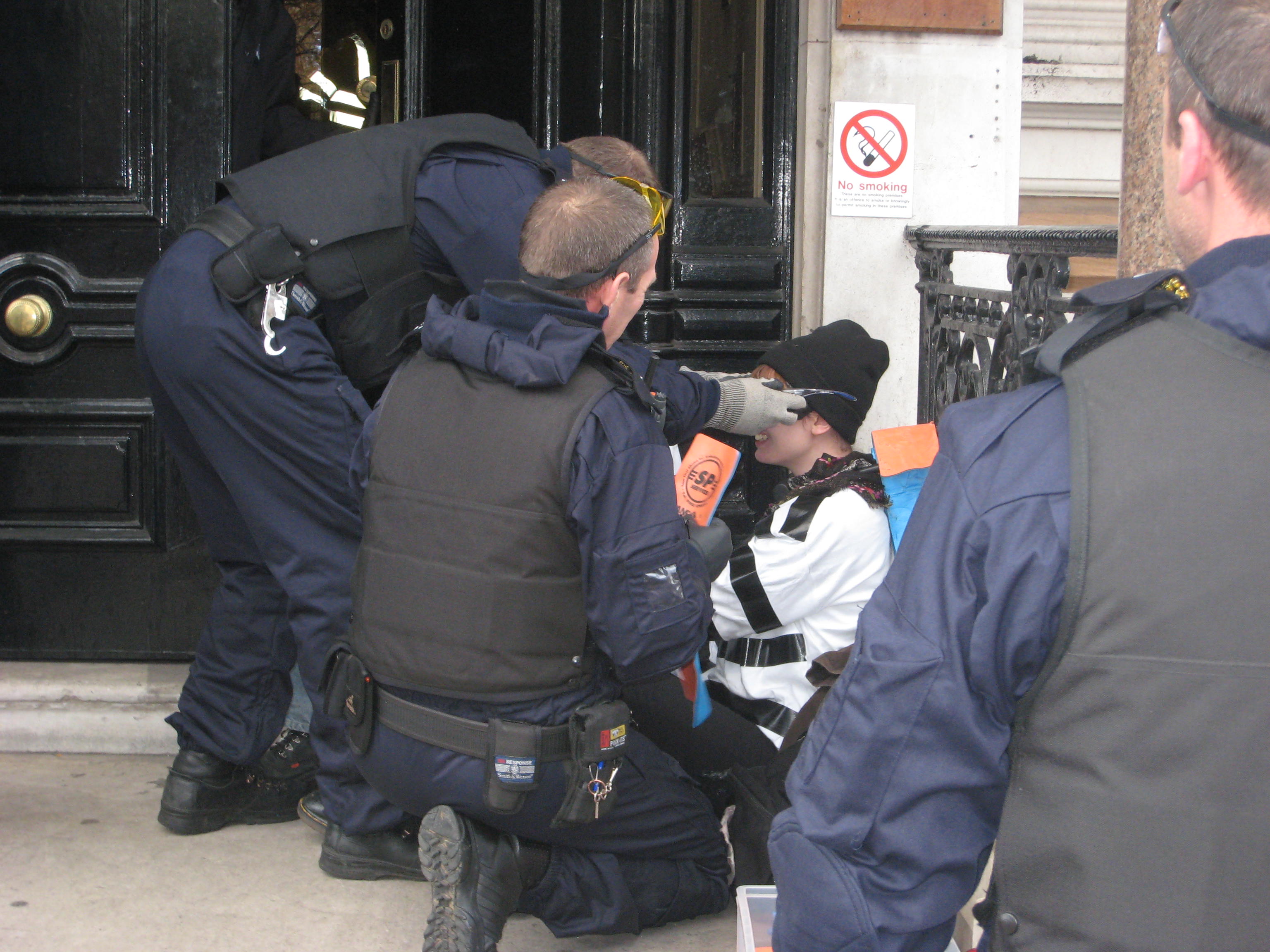
I was filming a protest a couple of weeks ago outside the International Chamber of Commerce where some activists had come along and locked/superglued themselves to the entrance in protest to the ICC representing corporate interests at the Copenhagen climate change talks. Whilst there I noticed one of the officers had on him what looked like thumbcuffs. I asked one of the officers, whom I presumed was the most senior officer on site at the time as the others were defferring to him, what they were, after a short conversation about whether the Met uses thumbcuffs during which he said “I shouldn’t think so, I haven’t seen them for years” (when did the Met use thumb cuffs?) he told me that it was a device for cutting seatbelts. Hmm, here’s some photos, decide for yourself.

I passed this on to a friend, who passed it on to a colleague who passed it on to a journalist who did some investigating. He contacted Scotland Yard for comment on this and an explanation into the thumbcuffs. Scotland yard said the unit these Police staff (not officers) are from are called the Method of Entry unit and are specialists in removing activists and entering locked premises. They had been on a training exercise that morning that had been about removing protesters that had locked themselves together using thumbcuffs when they were called to the action at the ICC. The officer should probably not have had these on him, but they are not used in normal service.

So there we are, not a scandal about British police using torture equipment on protesters, but a mistake by a specialist police unit and an interesting insight into the Met’s structure and training systems.

**Update 13-01-10**
The activists arrested during this demonstration were yesterday found guilty of aggrevated tresspass and fined £200. Their protest against the biggest corporate lobby group in Copenhagen highlighted the influence of corporates over the climate conference. If you can, please help them to pay their fine and legal fees, join the Facebook Group.

Add to FacebookAdd to DiggAdd to Del.icio.usAdd to StumbleuponAdd to RedditAdd to BlinklistAdd to TwitterAdd to TechnoratiAdd to Yahoo BuzzAdd to Newsvine