Are we heading for an Oil-Crunch?

worldofoilbybarbaradodukLeading environmentalists, major national companies and industry experts have increased calls for more action on what has been called the “oil crunch”. Environmental entrepreneur Jeremy Leggett wrote in The Guardian recently about how we are heading for an oil crunch within the next decade. Leggett heads up the UK Industry Task Force on Peak Oil and Energy Security and has warned how we could see the same crash that happened to the banks happening with global oil reserves. The task force has claimed that oil production will hit its peak in 2015 after which we will see a rapid decline in production whilst demand continues to increase, a claim supported by major UK companies such as Virgin and Stagecoach. The report by the task force highlights concerns that draw parallels with the causes of the credit crunch. They are concerned that there may be significant flaws in the oil reserve estimates by OPEC countries, similar to the flaws in the value placed on “toxic loans”. This would mean that demand would be even higher than estimated and could cause oil production to peak even earlier. The UK Government’s line on this has remained the same; that there is enough oil for the next 40 years and there is no crisis on the way, though I’m sure that’s what the Treasury and Bank of England were saying to the few economists that predicted the crash.

So what would an “oil crunch” mean? Well, as supply plummets and demand continues to increase, countries dependent on importing oil, such as the UK, would initially see increasingly large price rises, particularly for energy and fuel. On a global scale, countries that produce a lot of oil would become increasingly protectionist, particularly countries with histories of isolationist foreign policy such as the USA, China and Russia. This combined with neo-liberal (read ‘corporate influenced’) government and free-market economics pushes larger countries into conflict with oil-rich countries such as those in the Middle East.

A pretty dire future I think you’ll agree.

So, if we are plummeting towards this inevitable distopian future, is there any point in doing anything? Well, yes, or at least if we don’t do anything and we do continue to burn oil for the next 40 years, it won’t be the lack thereof that is a our biggest problem, we can kiss goodbye to staying below a 2oC rise in global temperatures. Far from being inevitable this is, in fact, evitable, very evitable. The answer is simple but, like cleaning up any mess, implementing the solution will require a huge effort and a lifestyle switch. What is the answer? Simple, we stop using oil, and there are a great many ways in which we can do this. In the UK, for example, the report from the task force suggests ending the, quite frankly absurd, £9billion tax break on fuel for domestic flights (which in a country the size of the UK are ludicrous anyway) and instead pumping it into public transport and boosting the renewable energy sector. If the subsidies that go into fossil fuel energy were put into developing sustainable, decentralised renewable energy, peak oil wouldn’t be anywhere near the problem that it is likely to be. If ever there was a good reason to look into fitting solar panels onto your roof, this is it.

And yes, I have noticed the obvious self-interest of SolarCentury owner Jeremy Leggett warning us of the perils of relying too much on oil, doesn’t make him any less right though.

UN REDD: Savior of the Rainforest or Stealth Free Market Exploitation?

The ancient forests are the lungs of the earth; without the forests life as we know it cannot exist on this planet. Deforestation and forest degradation, through agricultural expansion, conversion to pastureland, infrastructure development, destructive logging etc are destroying vast areas of forest at an alarming rate.

In Canada, tar sands extraction projects are destroying huge areas of Boreal forest, some of the largest areas of ancient forest left. The trees are clear-cut to allow the oil companies to access the tar sands underneath and are exported to the US to be turned into toilet paper. In Ecuador the Yasuni region has vast reserves of oil which oil companies have been exploiting for years, destroying the local environment and evicting the indigenous people in the process.

In total deforestation and forest degradation accounts for nearly 20% of global greenhouse gas emissions, more than the entire global transportation sector and second only to the energy sector. It is now clear that in order to constrain the impacts of climate change within limits that society will reasonably be able to tolerate, the global average temperatures must be stabilized within two degrees Celsius. This will be practically impossible to achieve without reducing emissions from the forest sector, in addition to other mitigation actions.

The United Nations launched the Collaborative Programme on Reducing Emissions from Deforestation and Forest Degradation(REDD) as a key means of reducing CO2 emissions suggested during the COP15 in Copenhagen. The aim is to create a financial incentive to protect these areas of forest by attributing a value to the carbon they store.

It is predicted that financial flows for greenhouse gas emission reductions from REDD could reach up to US$30 billion a year. This significant North-South flow of funds could reward a meaningful reduction of carbon emissions and could also support new, pro-poor development, help conserve biodiversity and secure vital ecosystem services.

There are some serious concerns around the REDD initiative however, particularly around the rights of the indiginous people. In a statement in September 2009 the International Indigenous Peoples Forum on Climate Change (IIPFCC) said:

“If there is no full recognition and full protection for indigenous peoples’ rights, including the rights to resources, lands and territories, and there is no recognition and respect of our rights of free, prior and informed consent, we will oppose REDD,”

Amazon Watch have published a list of concerns with the treaty, stating that the provisions that protect the indiginous peoples’ rights to the land and recognisiton of rights to free, prior and informed consent are either missing, or worded in such a way that would mean they were likely to be cut from a final draft. They also express significant concern over the economic model underpinning REDD being based on the free-market style carbon market. This would lead to “drastically restricted traditional customs and lifestyles, leading to displacement and impoverishment of indigenous peoples and forest-dependent communities” as well as “exacerbating conflict over land rights with local landowners and governments”. A spokesperson from Amazon Watch said:

“By turning forests into a highly-prized commodity, REDD could give way to forced evictions and essentially turn control over a given area of forest to private interests”

The Yasuni Green Gold campaign is an example of how this sort of project could work. Launched to try to protect the Yasuni National Park from destruction, the campaign called on the international community to pay $350m per year for 10 years for the government to keep the area free from development. The Yasuni Green Gold campaign is aimed at ensuring that the rights of the indiginous people in the area are respected and are enshrined in any deal or treaty governing the use of the area.

Add to FacebookAdd to DiggAdd to Del.icio.usAdd to StumbleuponAdd to RedditAdd to BlinklistAdd to TwitterAdd to TechnoratiAdd to Yahoo BuzzAdd to Newsvine

Support the Robin Hood Tax

robin_hood_mask-180x127A new campaign has just launched in the UK to build support for a tax on financial transactions called a Tobin tax (named after the American economist who proposed the tax in the 1970s James Tobin). Taking inspiration from the legend of Robin Hood, the medieval bandit who conducted his own brand of wealth redistribution, the campaign calls for a Robin Hood Tax.

The idea behind a Tobin tax is very simple concept that could raise hundreds of millions, if not billions, of dollars to go to alleviating poverty, mitigating climate change, curing diseases the list goes on. The idea works by charging a 0.05% tax on speculative transactions. As many thousands of these happen every day this would rapidly raise huge amounts of money.

A speculative transaction is one that has a typically very high risk of not returning the original investment. This is the type of financial transaction that was involved in the collapse of many banks recently – the buying and selling of debt is one of the most common forms of speculative transaction.

This latest initiative in the UK has given a huge boost to global Tobin tax campaginers. The Tobin tax was proposed by the UK and France at the UN Climate Change summit in Copenhagen last December as a way to raise the money needed to help developing countries to leap-frog carbon intensive development and go straight to renewables.

There are campaigns all over the world calling for the introduction of a Tobin tax as it needs to be implemented on a global scale. To find out where your nearest campaign is check out the Tobin Tax Campaign website.

Conservatives No-Thank-You

When the Tories make a fraudulent claim, they really make a fraudulent claim. Labour may have more MPs being charged but their crimes pale in insignificance compared to their Tory peer comrade. The Times reported this morning that Labour 3 MPs and one Tory Lord have been charged over the MP’s expenses scandal. The MPs are Elliott Morley, David Chaytor and Jim Devine – no doubt soon to be lifted from the depths of back-bench obscurity to become household names – and the peer is Lord Hanningfield.

Each of the three Labour MPs has committed serious fraud; David Chaytor having “flipped” his second home several times and claimed around £13000, Elliott Morley claimed around £16000 on a so-called “phantom” mortgage and Jim Devine claiming around £2157 and £2326 respectively for electrical and carpentry work that allegedly never happened. Now these are serious cases and should be delt as such but they are nothing when compared to the details of Lord Hanningfield’s claim.

Conservative peer Lord Hanningfield is being charged over claiming £100,000 for staying overnight in Lonodn despite living only 46 miles away. This seems to be a significantly more serious offense than those three Labour MPs are accused of.

This is just another reason that a conservative government is a bad idea. Look at the scale of the mistakes. Labour brought us two wars, both causing monumental loss of life and massive destabilisation in the middle-east. The last Conservative government gave us numerous wars, armed Saddam & the Mujahideen, destroyed British industry and created the laissez-faire economic system that brought us the recession.

Conservatives; no-thank-you-very-much.

Add to FacebookAdd to DiggAdd to Del.icio.usAdd to StumbleuponAdd to RedditAdd to BlinklistAdd to TwitterAdd to TechnoratiAdd to Yahoo BuzzAdd to Newsvine

The Downside to Collective Amnesia

Ok so there probably isn’t an upside to collective amnesia, but still are we really so goldfish-brained that we, as a nation, have forgotten what happened the last time we let the Eton-elite get behind the wheel? They’re the ones that presided over, some might say created, the laissez-faire economic system that created the recession. A perfectly planned time-bomb that will allow David Cameron to sweep into power with a landslide and set us up for the next round. I may have been young when John Major lost out to Tony “the Butcher” Blair, but I have not forgotten who the Conservatives are and what they stand for. I was recently speaking to a young Conservative who told me that “In order for a country to operate as a competitive entity there must be an elite, educate class and the state system simply cannot provide an education system capable of teaching these people”. David may have the air-brushed clean features of a Vogue model but the the heart of the conservatives is in the back benches – a seething mass of elitism, racism, homophobia and exploitation for profit.

Add to FacebookAdd to DiggAdd to Del.icio.usAdd to StumbleuponAdd to RedditAdd to BlinklistAdd to TwitterAdd to TechnoratiAdd to Yahoo BuzzAdd to Newsvine

Obama backs Nucelar, Biofuels & “Clean Coal”

Museum of Dumb Ideas by SkyBluePink

Last night US President Barack Obama pushed for agreement on the Climate Change Bill currently being re-re-re-re-written in the Senate, during his Sate of the Union address. It seems, however, that getting an agreement will come at a very high cost to the strength of the bill and, thereby, to the climate as well.

President Obama said he was “…eager to advance the bipartisan effort” indicated that he was willing to give some signifiant concessions to the Republicans in order to get agreement on the bill. So what has he agreed to? Obama opened the door for new nuclear power in the US and hinted that there will be more offshore oil drilling and has given his support to controversial biofuels and “clean coal”.

That means building a new generation of safe, clean nuclear power plants in this country. It means making tough decisions about opening new offshore areas for oil and gas development. It means continued investment in advanced biofuels and clean coal technologies

He also gave his support for a “comprehensive” bill which, according to The Guardian’s Suzanne Goldenberg, means it will be broad and pave the way for a cap-and-trade system. This will likely leave plenty of loop-holes for clever fossil-fuel company lawyers to get stuck into.

Obama said “Yes we can save this world” well, not if he acts like this.

Add to FacebookAdd to DiggAdd to Del.icio.usAdd to StumbleuponAdd to RedditAdd to BlinklistAdd to TwitterAdd to TechnoratiAdd to Yahoo BuzzAdd to Newsvine

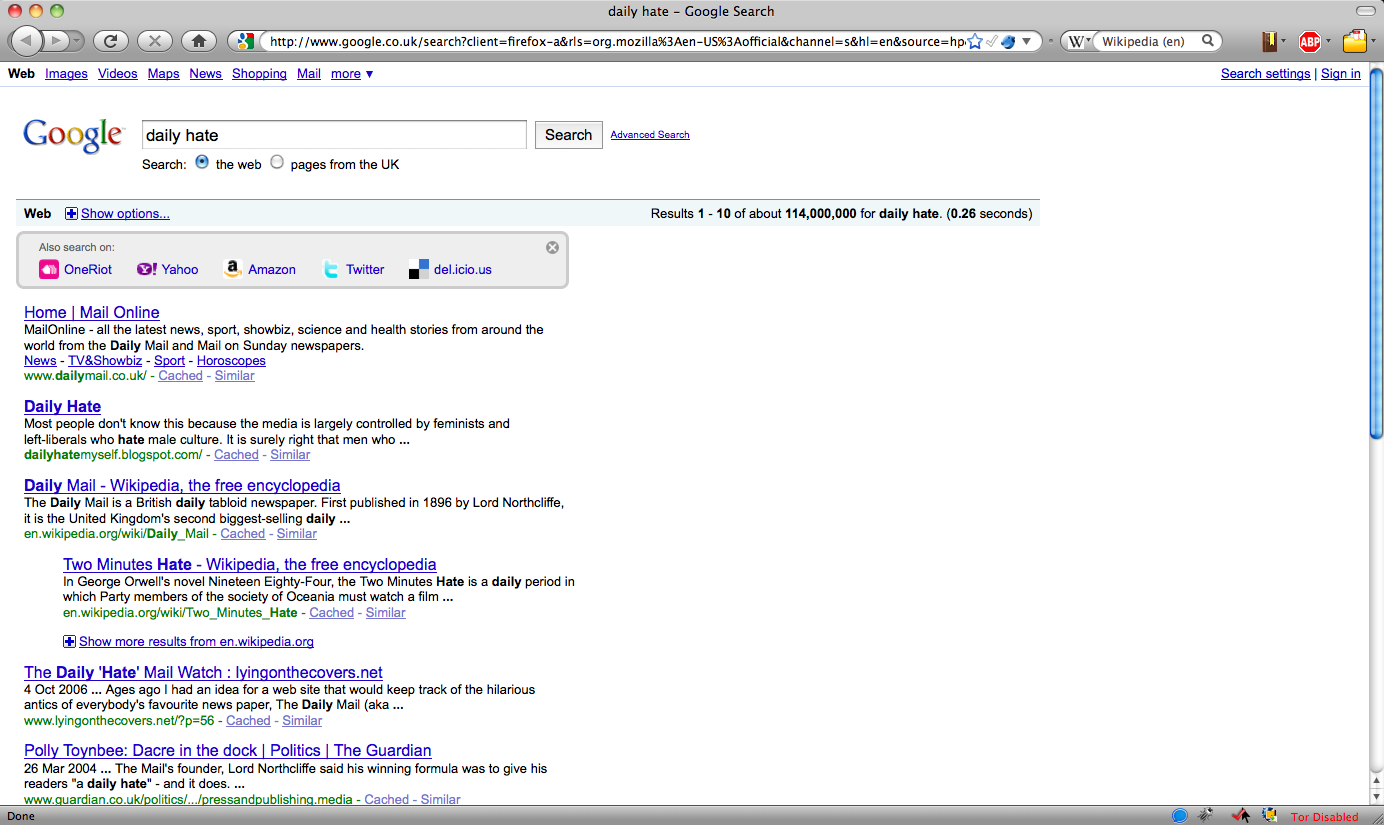
Screengrab of the Day: Daily Hate

Yesterday marked 76 years since the article in the Daily Mail where Lord Rothermere, the editor at the time, declared “Hurrah for the Blackshirts”, that being the front-page headline. The article praised Oswald Moseley and the British Union of Fascists for their “…commonsense conservative doctrine”. Rothermere was also a friend of Mussolini and Hitler, praising the latter as “Adolf the Great” and hoped he would become a popular figure in Britain.

Just out of interest I typed “Daily Hate” into Google and look what turned up as the top search result (more after the image):

Rather amusingly somone set up hurrahfortheblackshirts.co.uk that auto-forwards to the Daily Mail’s website. Unfortunately after the threat of legal action from the afore mentioned rag it has been stopped.

Add to FacebookAdd to DiggAdd to Del.icio.usAdd to StumbleuponAdd to RedditAdd to BlinklistAdd to TwitterAdd to TechnoratiAdd to Yahoo BuzzAdd to Newsvine

No Shock Doctrine for Haiti

A friend’s post on Left Foot Forward, definitely worth a read:

News stories about Haiti are full of tales of looters. There’s less talk of a bigger scale plunder to come. In Naomi Klein’s ‘The Shock Doctrine‘ she maps the rise of “disaster capitalism”. She describes how, over 40 years, The International Monetary Fund (IMF), Pentagon, and various mega-corporations have increasingly used (or created) disasters as an excuse to push through unpopular right wing economic policies, and asset strip vulnerable economies.


Read the full article

Join the No Shock Doctrine for Haiti Facebook group

Equator Principles: More what you’d call guidelines than actual rules

The Guardian today reported that campaigners have sent a letter to the banks that make up the signatories for the Equator Principles, a set of standards for environmental and social impact for project finance, stating that banks routinely ignore them and continue to provide finance to some of the most damaging projects. To which the banks collectively responded by saying “Aargh me hearties, the Principles be more what you’d call guidelines than actual rules“.

A few years ago I wrote a short case study on BP’s Baku-Tbilisi-Ceyhan (pronounced Chey-han) pipeline, which was financed through a $1.6billion loan from 15 banks including 10 signatories to the Equator Principles. The pipeline is the second longest in the world and is capable of pumping a millions barrels a day from Baku on the Azerbaijani coast of the Black Sea to the Turkish port of Ceyhan on the Mediterranean. An independent report by a group of international NGOs found that the pipeline had more than 137 breaches of the Equator Principles including 90 breaches of the World Bank’s standards for social and environmental impact. This is just one of MANY projects that are financed every year by banks that pay absolutely no attention whatsoever to the Principles, they are simply used to boost corporate social responsibility reports.

Further reading:
Case Study: Baku-Tbilisi-Ceyhan
Baku-Ceyhan Campaign
PLATFORM

Add to FacebookAdd to DiggAdd to Del.icio.usAdd to StumbleuponAdd to RedditAdd to BlinklistAdd to TwitterAdd to TechnoratiAdd to Yahoo BuzzAdd to Newsvine

Google Ditch China over Cyber Attacks

Google have announced that they may be closing their services in China following a “highly sophisticated and targeted attack on our corporate infrastructure originating from China”. They went on to say that the attacks, originating in China were directed at advocates of human rights in China.

Well the first thing to say is “About f**king time!”. As an activist in the Tibetan freedom movement I have received numerous attacks on my email account, as many as 10 in one day during the Olympics! Some of these are more sophisticated than others – the vast majority are VERY easy to spot as they use broken English and contain attachments from people I don’t know. Others are much more clever. One I received during the Olympics appeared to be from a colleague, they had cloned her email account and had written the email in fluent and clear English. It just so happened that I was sat in the office with that particular colleague at the time. In another instance I received an email appearing to be from a former colleague and friend who had recently left. The email address was right and the personal facts in the email – they knew where he worked and that he had recently left – were also right. They also knew our most basic security procedure – not opening attachments unless they were expected – and said in one email that they would send a document in the next. To be sure I rang the person the email was supposed to have come from and he had no knowledge of it at all. The attachments in both these cases were sent to an expert in computer viruses who did some analysis and found that the emails had some very sophisticated zero-day viruses and had originated in China. Though it cannot be definitively proven, it is widely believed that the attacks come from civilians in China who are recruited by the military specifically for this purpose, often from leading computer science universities.

It is telling that Google has gone public with this before talking to Chinese officials. This will have pissed the Chinese government off no end (always a good thing in my book), but also meant that unless there is a serious commitment to more openness from the Chinese government it makes it more likely that Google will leave.

Add to FacebookAdd to DiggAdd to Del.icio.usAdd to StumbleuponAdd to RedditAdd to BlinklistAdd to TwitterAdd to TechnoratiAdd to Yahoo BuzzAdd to Newsvine